


• Life, health and Medicare Advantage
  • 727-459-1887
  • eddie@yourcarerep.com
Your Care Rep Life Health and Medicare AdvantageYour Care Rep Life Health and Medicare AdvantageYour Care Rep Life Health and Medicare AdvantageYour Care Rep Life Health and Medicare Advantage
  • Home
  • About
    • Events
    • Join Our Team!
    • Get Contracted!
  • Services
    • RSSA Consultation Services
    • SSDI Disability
    • Enroll
    • Download Medicare & You 2025
    • 2024 Medicare Costs
    • Rx Savings
    • Dental
      • NCD Dental Flyer
      • NCD Dental Enroll
      • Spirit Dental
      • Denali Dental
  • Turning 65
  • Caregivers
  • Veterans
  • Webinars
    • AEP and 2025 NEW Drastic Medicare Changes MUST SEE Webinar
    • Unraveling the Mystery of Social Security and Learning How to Optimize It!
    • Veterans, Medicare and TriCARE For Life
    • Veteran’s Help Request Form
    • Boosting Medicare, Insurance and Annuity Sales with Social Security Expertise
    • Veterans Employment Recorded Webinar
  • Blog
  • Contact
RSSA Consult
✕
caring for a senior

If You Care for a Senior or Disabled Person, Here Are Answers to Common Questions: Part 1

caring for a senior

Caring for a person in need can be exhausting and frustrating. Having to make decisions for another person’s health is almost a full-time job. I know. I did it for my mom for three years. During that time, I’ve learned things that can help you avoid mistakes I made. So, here are some answers to commonly asked questions.

First let me start by saying, those of you who are in this role, you are angels without wings. As you age, you will see how important the assistance you provided was and the huge difference it made in savings, comfort, peace of mind and, of course, quality of life. So, when you feel like throwing in the towel, take a deep breadth and know you are storing treasure in Heaven and making a difference.

This will be a four-part series covering 16 questions regarding care for seniors and the disabled, whether veteran or civilian. We will talk about:

  • SSD and SSI recipients
  • Veterans benefits and Tricare for Life and VA Champs
  • Medicare beneficiaries
  • What to do if you have an overdose due to dementia.
  • What resources are available for those who need care while the caregiver is working.
  • Coverage while traveling
  • And more!

So, if you have not subscribed to our newsletter, you may want to do so to avoid missing these must-read articles. Okay, let’s get to the first four questions.

How can I learn what my care receiver is eligible for?

There are several ways you can check eligibility:

  • Online at SSA.gov (if you don’t have an account, create one)
  • Calling Social Security directly at 800-772-1213 (for TTY call 800-325-0778)
  • Calling Medicare at 800-Medicare (800-633-4227)
  • Calling a licensed insurance agent who specializes in Medicare

The easiest and most beneficial is the last one. By calling a fiduciary, like YourCareRep.com, you have an agent who does not work for any insurance carrier; however, he or she contracts with multiple to be able to find the best fit for your needs. We can call very easily and learn what your care receiver is eligible for and provide guidance on other programs (if he or she qualifies) that they may qualify for.

Medicare and Social Security are behemoth organizations who are not designed for individual assessment. While an agent specializes in your area and having helped hundreds of people, know the intricate details of the system and how they best help you.

Drug copays are too expensive. Is there any help available to lower prescription costs?

If your care receiver is on Medicare, then he or she may qualify for the Extra Help (LIS) program. LIS stands for low-income subsidy. There are certain criteria that must be met. They include:

  • How many people live in your household? For example, if your grandchildren live with you, or your care giver lives with you, then they are added to the number of the household.
  • How much do you earn, annually?
  • Other than your home, car and any term life insurance you may have (these are not counted as assets or resources), how much do you have in assets and resources?

If you click here, then click on See 2021 Federal Poverty Levels, you can see the qualifications. If you do qualify or believe you may, you can go apply for Extra Help here.

Subscribe to our newsletter and get the FREE Medical Information document for streamlined emergencies or hospitalization. A MUST HAVE FOR CARETAKERS! Don’t let changes take you by surprise! Stay in the know.


Even though my care receiver has insurance, he or she still can’t afford the bills. What are his or her options?

If you are having difficulty sustaining yourself financially, you can also apply for a Medicare Savings Program (MSP – Medicaid assistance). When you looked at the 2021 Federal Poverty Levels to see if you qualify for Extra Help, if you fall into the 135% or less column, then you may also qualify for an MSP.

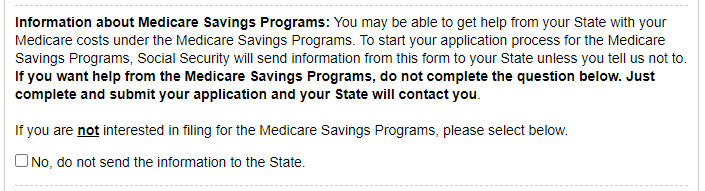
When filling out the application for Extra Help, you will see the following question:
Extra Help application MSP question

If you wish to apply, DO NOT CHECK THE BOX! If you check the box, they will not send your information to the state to apply for an MSP.

With so many plans to choose from, how do I know I’ve chosen the right plan for my care receiver?

This is a very good question. While you can figure this out on your own, it would be easiest to speak with a fiduciary agent. They will conduct a needs analysis to identify what your care receiver may be eligible for and make suggestions based on:

  • Financial resources
  • Lifestyle
  • Health conditions (if necessary to choose a Special Needs Plan)
  • Goals
  • Providers and facilities available
  • Benefits and incentives

When choosing a plan, all the above must be considered. If your care receiver qualifies for the aforementioned programs (Extra Help and MSP), they will help you enroll. If they don’t, there may be plans that provide Part-B premium givebacks that help pay the premium Medicare deducts from his or her social-security check.

If your care receiver is a frequent traveler, certain plans need to be considered that may provide a broader network that can be used while traveling, and/or emergency and urgent care while on the road. While many plans offer the latter, not all benefits are equal. You will want to look at the Summary of Benefits to determine which one is right for your care receiver.

Also, many plans offer different forms of additional benefits and incentives that add up to real money in one’s bank account. Such as:

  • Over-the-counter allowance (OTC) of $20 to $100 per month for items you are currently buying at CVS, Walgreens, Walmart or your favorite store.
  • Food cards ranging from $25 to $100 per month for grocery items.
  • Dental benefits that are either insurance or an allowance.
  • Free transportation to appointments which saves on gas or Uber.
  • Free meals after hospitalization.
  • And more, depending on the plan.

If you feel you may have the wrong plan, you can change it during an election or enrollment period. There are four kinds of election periods:

  1. (IEP) Initial Election Period (when you are turning 65)
  2. (AEP) Annual Election Period (October 15th through December 7th)
  3. (OEP) Open Enrollment Period (January 1st through March 31st – only for Medicare Advantage beneficiaries)
  4. (SEP) Special Election Period.

SEPs are triggered when special circumstances occur. There are quite a few. While this list is not extensive, it gives you an idea of when you may be able to change a plan, should the need arise.

  • If your financial situation changes for the worse.
  • If you move out of your plan area.
  • If your plan were to be cancelled or you are disenrolled (like when moving).
  • If your health condition changes.

If you feel you need to change your plan and do not know if you are eligible to do so, always remember you can engage an agent who will help you. We have access to resources that allow us to get you answers quickly, instead of being on endless hold with Medicare or Social Security.

Next week’s article will answer the following questions:

  1. What’s the difference between SSD/SSDI and SSI, and why it matters?
  2. How does SSD/SSDI and SSI affect when one qualifies for healthcare benefits?
  3. My care receiver, who’s on SSD/SSDI is eligible for Medicare. What should I do?
  4. My care receiver didn’t take Medicare Part-B because he or she couldn’t afford the premium. What are his or her options?

Again, if you found this article on Facebook or LinkedIn and found it helpful, subscribe to our newsletter so you don’t miss the next three (3) articles in the series. Furthermore, if you have a particular question, feel free to email it to ed***@*********ep.com, or post it in the comments section below. I will get back to you rapidly with an answer. Stay tuned!

Share
1
Eddie Velez | Licensed Florida Medicare Advantage Specialist

Eddie Velez | Licensed Florida Medicare Advantage Specialist

Eddie Velez is a former combat infantry Marine, and a Florida licensed insurance agent, specializing in Medicare Advantage and life insurance. With over 15 years serving seniors in a ministerial position, and with healthcare through Care Entrée. And now offering 5-star rated plans with Cigna, CarePlus, Aetna, Humana and UnitedHealthcare (coming soon, Florida Blue), plus Mutual of Omaha for life, and GTL and Prosperity for Hospital Indemnity and final expense insurance. Eddie is patient, caring and will get you the most benefits at the highest savings possible.

Related posts

Happy senior

Medicare Is on the Verge of Having Their Best Year After Their Worst Year, Due to the Inflation Reduction Act of 2022


Read more
NEW SSA.gov Online Account Security Changes: How to Set it Up In 7 Simple Steps

NEW SSA.gov Online Account Security Changes: How to Set it Up In 7 Simple Steps


Read more
Medicare Prescription Payment Plan

3 Things to Know About the Medicare Prescription Payment Plan


Read more

Leave a Reply Cancel reply

Your email address will not be published. Required fields are marked *

✕
Medicare and You 2025
Download TriCare For Life Handbook
Download CHAMPVA Guide


Latest Articles

  • Happy senior0
    Medicare Is on the Verge of Having Their Best Year After Their Worst Year, Due to the Inflation Reduction Act of 2022
    May 13, 2025
  • NEW SSA.gov Online Account Security Changes: How to Set it Up In 7 Simple Steps0
    NEW SSA.gov Online Account Security Changes: How to Set it Up In 7 Simple Steps
    March 31, 2025
  • Medicare Prescription Payment Plan0
    3 Things to Know About the Medicare Prescription Payment Plan
    February 16, 2025

Have A Question?


    By submitting this form you’ll be contacted by a licensed insurance agent.

    Veteran owned and operated
    Registered Social Security Analyst, RSSA
    AHIP certification

    We do not offer every plan available in your area. Any information we provide is limited to those plans we do offer in your area.
    Please contact Medicare.gov or 1-800-MEDICARE to get information on all of your options.

    YourCareRep LLC™ FL License L117279 ©2020 - 2024 | All Rights Reserved | Privacy Policy | Website designed by Success By Design
    RSSA Consult
    Accessibility
    Accessibility modes
    Epilepsy Safe Mode
    Dampens color and removes blinks
    This mode enables people with epilepsy to use the website safely by eliminating the risk of seizures that result from flashing or blinking animations and risky color combinations.
    Visually Impaired Mode
    Improves website's visuals
    This mode adjusts the website for the convenience of users with visual impairments such as Degrading Eyesight, Tunnel Vision, Cataract, Glaucoma, and others.
    Cognitive Disability Mode
    Helps to focus on specific content
    This mode provides different assistive options to help users with cognitive impairments such as Dyslexia, Autism, CVA, and others, to focus on the essential elements of the website more easily.
    ADHD Friendly Mode
    Reduces distractions and improve focus
    This mode helps users with ADHD and Neurodevelopmental disorders to read, browse, and focus on the main website elements more easily while significantly reducing distractions.
    Blindness Mode
    Allows using the site with your screen-reader
    This mode configures the website to be compatible with screen-readers such as JAWS, NVDA, VoiceOver, and TalkBack. A screen-reader is software for blind users that is installed on a computer and smartphone, and websites must be compatible with it.
    Online Dictionary
      Readable Experience
      Content Scaling
      Default
      Text Magnifier
      Readable Font
      Dyslexia Friendly
      Highlight Titles
      Highlight Links
      Font Sizing
      Default
      Line Height
      Default
      Letter Spacing
      Default
      Left Aligned
      Center Aligned
      Right Aligned
      Visually Pleasing Experience
      Dark Contrast
      Light Contrast
      Monochrome
      High Contrast
      High Saturation
      Low Saturation
      Adjust Text Colors
      Adjust Title Colors
      Adjust Background Colors
      Easy Orientation
      Mute Sounds
      Hide Images
      Hide Emoji
      Reading Guide
      Stop Animations
      Reading Mask
      Highlight Hover
      Highlight Focus
      Big Dark Cursor
      Big Light Cursor
      Cognitive Reading
      Virtual Keyboard
      Navigation Keys
      Voice Navigation

      YourCareRep

      Accessibility Statement

      • yourcarerep.com
      • November 9, 2026

      Compliance status

      We firmly believe that the internet should be available and accessible to anyone, and are committed to providing a website that is accessible to the widest possible audience, regardless of circumstance and ability. To fulfill this, we aim to adhere as strictly as possible to the World Wide Web Consortium’s (W3C) Web Content Accessibility Guidelines 2.1 (WCAG 2.1) at the AA level. These guidelines explain how to make web content accessible to people with a wide array of disabilities. Complying with those guidelines helps us ensure that the website is accessible to all people: blind people, people with motor impairments, visual impairment, cognitive disabilities, and more. This website utilizes various technologies that are meant to make it as accessible as possible at all times. We utilize an accessibility interface that allows persons with specific disabilities to adjust the website’s UI (user interface) and design it to their personal needs. Additionally, the website utilizes an AI-based application that runs in the background and optimizes its accessibility level constantly. This application remediates the website’s HTML, adapts Its functionality and behavior for screen-readers used by the blind users, and for keyboard functions used by individuals with motor impairments. If you’ve found a malfunction or have ideas for improvement, we’ll be happy to hear from you. You can reach out to the website’s operators by using the following email eddie@yourcarerep.com

      Screen-reader and keyboard navigation

      Our website implements the ARIA attributes (Accessible Rich Internet Applications) technique, alongside various different behavioral changes, to ensure blind users visiting with screen-readers are able to read, comprehend, and enjoy the website’s functions. As soon as a user with a screen-reader enters your site, they immediately receive a prompt to enter the Screen-Reader Profile so they can browse and operate your site effectively. Here’s how our website covers some of the most important screen-reader requirements, alongside console screenshots of code examples:
      1. Screen-reader optimization: we run a background process that learns the website’s components from top to bottom, to ensure ongoing compliance even when updating the website. In this process, we provide screen-readers with meaningful data using the ARIA set of attributes. For example, we provide accurate form labels; descriptions for actionable icons (social media icons, search icons, cart icons, etc.); validation guidance for form inputs; element roles such as buttons, menus, modal dialogues (popups), and others. Additionally, the background process scans all of the website’s images and provides an accurate and meaningful image-object-recognition-based description as an ALT (alternate text) tag for images that are not described. It will also extract texts that are embedded within the image, using an OCR (optical character recognition) technology. To turn on screen-reader adjustments at any time, users need only to press the Alt+1 keyboard combination. Screen-reader users also get automatic announcements to turn the Screen-reader mode on as soon as they enter the website. These adjustments are compatible with all popular screen readers, including JAWS and NVDA.
      2. Keyboard navigation optimization: The background process also adjusts the website’s HTML, and adds various behaviors using JavaScript code to make the website operable by the keyboard. This includes the ability to navigate the website using the Tab and Shift+Tab keys, operate dropdowns with the arrow keys, close them with Esc, trigger buttons and links using the Enter key, navigate between radio and checkbox elements using the arrow keys, and fill them in with the Spacebar or Enter key.Additionally, keyboard users will find quick-navigation and content-skip menus, available at any time by clicking Alt+1, or as the first elements of the site while navigating with the keyboard. The background process also handles triggered popups by moving the keyboard focus towards them as soon as they appear, and not allow the focus drift outside of it. Users can also use shortcuts such as “M” (menus), “H” (headings), “F” (forms), “B” (buttons), and “G” (graphics) to jump to specific elements.

      Disability profiles supported in our website

      • Epilepsy Safe Mode: this profile enables people with epilepsy to use the website safely by eliminating the risk of seizures that result from flashing or blinking animations and risky color combinations.
      • Visually Impaired Mode: this mode adjusts the website for the convenience of users with visual impairments such as Degrading Eyesight, Tunnel Vision, Cataract, Glaucoma, and others.
      • Cognitive Disability Mode: this mode provides different assistive options to help users with cognitive impairments such as Dyslexia, Autism, CVA, and others, to focus on the essential elements of the website more easily.
      • ADHD Friendly Mode: this mode helps users with ADHD and Neurodevelopmental disorders to read, browse, and focus on the main website elements more easily while significantly reducing distractions.
      • Blindness Mode: this mode configures the website to be compatible with screen-readers such as JAWS, NVDA, VoiceOver, and TalkBack. A screen-reader is software for blind users that is installed on a computer and smartphone, and websites must be compatible with it.
      • Keyboard Navigation Profile (Motor-Impaired): this profile enables motor-impaired persons to operate the website using the keyboard Tab, Shift+Tab, and the Enter keys. Users can also use shortcuts such as “M” (menus), “H” (headings), “F” (forms), “B” (buttons), and “G” (graphics) to jump to specific elements.

      Additional UI, design, and readability adjustments

      1. Font adjustments – users, can increase and decrease its size, change its family (type), adjust the spacing, alignment, line height, and more.
      2. Color adjustments – users can select various color contrast profiles such as light, dark, inverted, and monochrome. Additionally, users can swap color schemes of titles, texts, and backgrounds, with over 7 different coloring options.
      3. Animations – epileptic users can stop all running animations with the click of a button. Animations controlled by the interface include videos, GIFs, and CSS flashing transitions.
      4. Content highlighting – users can choose to emphasize important elements such as links and titles. They can also choose to highlight focused or hovered elements only.
      5. Audio muting – users with hearing devices may experience headaches or other issues due to automatic audio playing. This option lets users mute the entire website instantly.
      6. Cognitive disorders – we utilize a search engine that is linked to Wikipedia and Wiktionary, allowing people with cognitive disorders to decipher meanings of phrases, initials, slang, and others.
      7. Additional functions – we provide users the option to change cursor color and size, use a printing mode, enable a virtual keyboard, and many other functions.

      Browser and assistive technology compatibility

      We aim to support the widest array of browsers and assistive technologies as possible, so our users can choose the best fitting tools for them, with as few limitations as possible. Therefore, we have worked very hard to be able to support all major systems that comprise over 95% of the user market share including Google Chrome, Mozilla Firefox, Apple Safari, Opera and Microsoft Edge, JAWS and NVDA (screen readers), both for Windows and for MAC users.

      Notes, comments, and feedback

      Despite our very best efforts to allow anybody to adjust the website to their needs, there may still be pages or sections that are not fully accessible, are in the process of becoming accessible, or are lacking an adequate technological solution to make them accessible. Still, we are continually improving our accessibility, adding, updating and improving its options and features, and developing and adopting new technologies. All this is meant to reach the optimal level of accessibility, following technological advancements. For any assistance, please reach out to eddie@yourcarerep.com